
Senator Richard Blumenthal
September 4, 2026 · Newsletter
Ukraine is Turning the Tide Against Russia—But We Must Continue Our Support
The real-life cruelty of Putin’s bloody, slaughtering invasion hit me as I walked through a military hospital in Dnipro, observing gruesome wounds of fighters taken from the front nearby—some in ongoing surgery or intensive care, losing limbs and possibly lives.
Their sacrifices are part of the cost of Russia’s criminal inhumanity—but only a part. In Dnipro, where I was the first member of Congress permitted to visit since the invasion’s start in 2022, the fight was close by—there have been 18,000 drone and missile attacks this year alone. Civilians are relentlessly targeted, 16 killed at a supermarket only days before my stop.
On this visit to Ukraine, my 11th, the war seemed nearer—everywhere. Air raids sounded every night. Almost every street seems to have some damaged buildings. The prospect of another long, frigid winter—with energy sources under constant bombing and desperate shortages of heat—looms large.
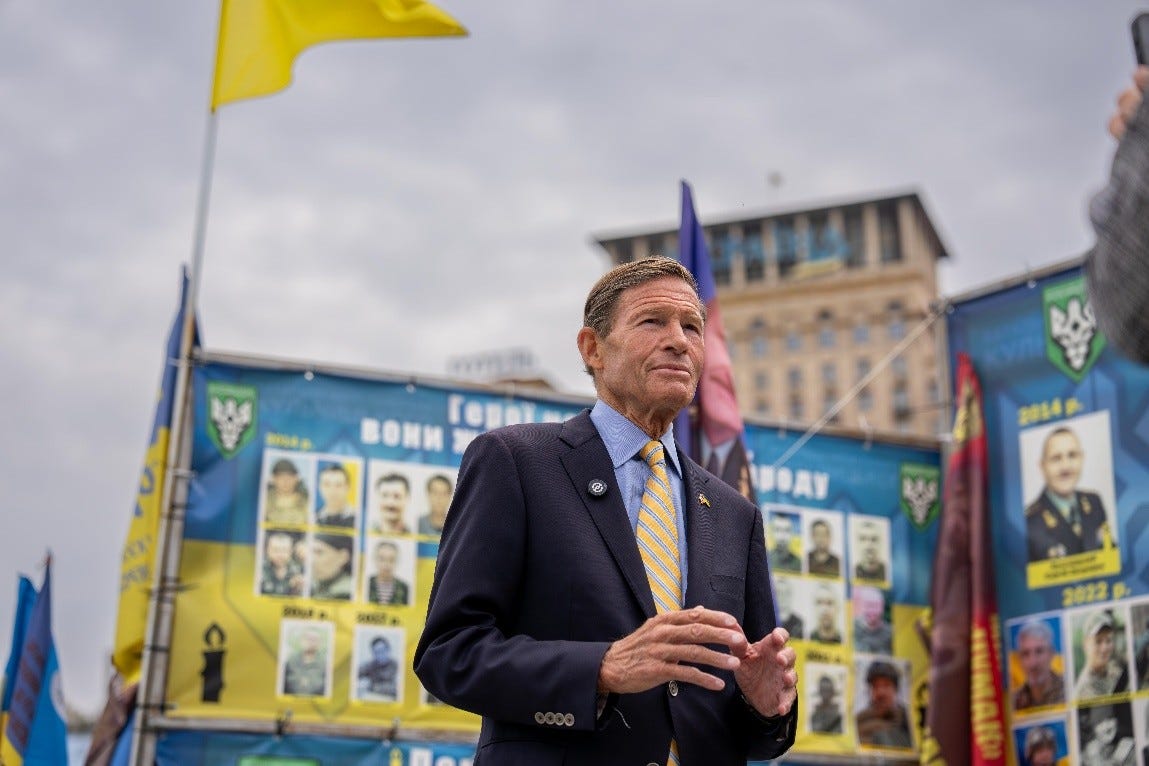
While in Kyiv, I visited Independence Square and Babyn Yar, celebrated Ukraine’s Independence Day, and attended a National Prayer Breakfast.
Increasingly, American businesses are hit—repeatedly and purposely. Almost half of all U.S. companies have suffered damage from missile and drone strikes, intentionally aimed at them, many repeatedly. Unfortunately, almost all have remained silent, in fear of reprisal.
But there’s also the sense that Ukraine has turned the tide. Russia’s combat casualties have skyrocketed to 35,000 a month, which is unsustainable without full scale mobilization, an anathema to Putin. The ground war has stalemated, or at least stalled, as Ukraine makes small net gains in territory for the first time in a while.
Most important, Ukraine is hitting key targets deep inside Russia using advanced unmanned aerial technology that has inspired awe and admiration in our own military and around the world. In fact, Ukraine has provided direct assistance to Middle East countries under attack by Iran as well as advice to U.S. armed forces.
Another key factor is Russia’s spreading economic weakness. Russia’s economy is under unprecedented pressure, potentially on the cusp of major crisis. As Putin’s budget deficit spikes to $125 billion (almost 5 percent of GDP), his military consuming 60% of his budget, and an interest rate of 14 percent on government debt, he’ll face an economic reckoning. The fiscal crunch is coming.
At this crucial moment, the Russia Sanctions bill would be especially impactful and important—cutting the flow of revenue from Russian sales of oil and gas is more necessary than ever to fuel Putin’s war machine. Sweeping sanctions on Russian energy companies, oligarchs, financial institutions and others, along with secondary tariffs narrowly targeting the five largest purchasers of Russian oil and gas, plus a crackdown on evader facilitators and the shadow fleet—combined and coordinated, their effect would be a strategic sledgehammer.
Hence, in my meeting with President Zelenskyy, his first priority and the number one homework assignment I took away was to seek passage of the bill, known formally as the Lindsey O. Graham Sanctioning Russia Act, which I have led with the late Lindsey Graham. It passed the Senate by an overwhelming bipartisan vote of 86-11, reflecting broad American support for Ukraine’s cause, a few weeks after Senator Graham’s untimely passing in early July.
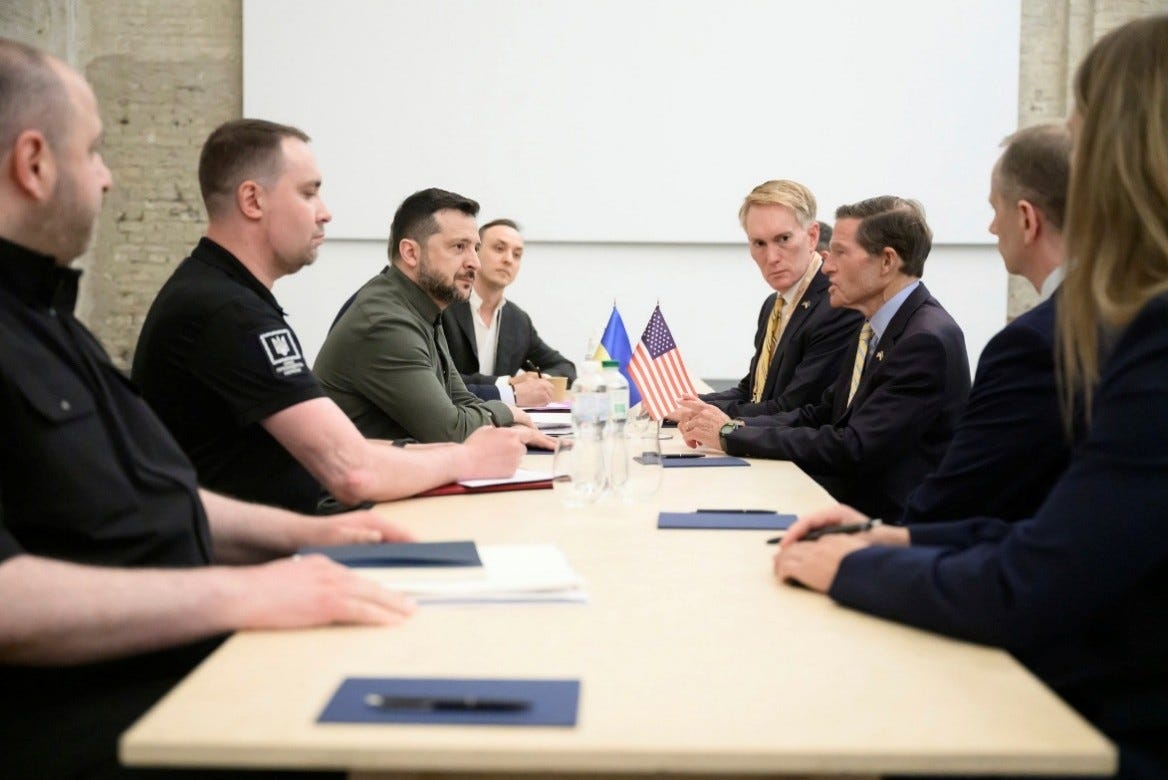
See more about my meeting with President Zelenskyy here.
Now, we need to get it through the House in the same form. The bill is the product of painstaking, sometimes painful, negotiations that I spearheaded with Sen. Graham involving the White House, U.S. Trade Representative, Congressional colleagues, and others. The goal was to confine the new authority to predominant purchasers of Russian energy products, China and India being the two largest by far. Changes in the bill now would imperil the balance we struck.
When I asked President Zelenskyy whether he’d be willing to talk to House members, as he did Senators before the vote, he enthusiastically agreed. When the Senate voted weeks ago, he was in the Gallery, watching this historic moment. I was impressed by how dramatically important he thought the Sanctions bill would be to Ukraine’s fight.
Equally important on his list of priorities, a second homework item, is air defense. Ukraine simply no longer has Patriot system or THAAD interceptors or other devices to shoot down the Russian missiles that pummel schools, hospitals, apartment houses, energy plants, and other civilian facilities literally every day. They’re in short supply in our own military because President Trump’s Iran War has consumed so many.
Ukraine can’t rely only on American manufacturers of such interceptors—they’re too slow and costly—so it must develop other means of air defense. One solution is to make its own interceptors, after American companies share licenses. But such home grown manufacturing is likely to take more time and resources than Ukraine can afford, as Zelenskyy acknowledges, even with its incredible ingenuity and skill.
It must innovate and invent new devices and means of air defense—not just more hardware, but an air defense strategy that hits Russian missile manufacturers and missile launch pads and similar targets. In effect, it must stop the missiles and drones before they’re even fired. Hit them at the source to stymie their savage toll.
To aim with higher accuracy, Zelenskyy needs Starlink over Russia—his third priority and homework assignment for me. He has access to Starlink for the battlefield in Ukraine, and his troops have used it to devastating effect. Now he’s seeking it to guide his own missiles and drones to pinpoint Putin’s most critical assets. It could be a game changer.
What he needs for Starlink is a green light from Elon Musk, which almost certainly means first from President Trump. He’s asked for it and is awaiting a decision. Anyone with influence over either, now is the time. If Sen. Graham were still with us, he would be the critical force—all in, engaged. One more example of how his role is so difficult, perhaps impossible, to fill.
Actually, the priorities Zelenskyy articulated to me echoed requests and homework assignments that he has previously expressed to both Sen. Graham and me in numerous meetings with him before. And they show how some of the key factors in this war have shifted—from brawn to brains.
Nothing is more important than the bravery, resolve, and strength of battlefield fighters, but their lethality and effectiveness is increasingly dependent on advancing technology and their skill in deploying it. It isn’t just the awesomely quick and nimble hardware, but the amazing expertise of troops in using it. What they’re demonstrating in combat, and teaching other armed forces, is how to find, define, and destroy enemy positions—with stealth and precision.
They’re also innovating in real time—rapidly and cost effectively—as I saw in my visit to SkyFall, a Ukrainian manufacturer operating two shifts every day to produce thousands of Vampire drones and inventing new unmanned platforms that seem straight out of science fiction. It’s an arms race that tests who is smarter and swifter, as much as who has more troops.
This kind of shift in the war favors Ukraine. Russia has superiority in troop numbers—by virtue of its being triple in population—but it seems outmatched by Ukraine’s data driven, fact-based strategy, not to mention ingenuity and agility. Their survival is at stake.
Walking through SkyFall’s assembly line, constructed more than five floors underground in a former parking garage, I was reminded of America’s “can do” attitude in a crisis. In World War II, for example, auto plants were converted into plane or tank manufacturing, producing numbers never thought possible. This one plant in Ukraine is making more than a thousand drones every day—compared to America’s current industrial base that struggles to manufacture hundreds in a year.
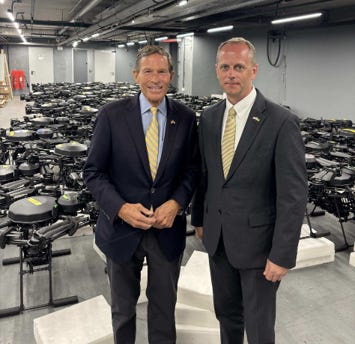
Touring SkyFall with new US Embassy Kyiv Chargé d’Affaires Paul Houston. See more about my visit here.
President Zelenskyy is the first to acknowledge that Ukraine needs help—sanctions, air defense, Starlink, and, of course, financial assistance to close gaps in funding he needs to buy more munitions and everything else. And he is also first to thank the United States for its huge help so far.
America no longer finances arms purchases. It sells them. Europe has stepped up dramatically to fill the gap, and President Zelenskyy is readily thankful to the Coalition of the Willing.
This trip—and all my previous ones—wouldn’t be possible without the smart and savvy embassy staff tasked with coordinating logistics, assessing and managing security risks, and providing substantive briefings into local dynamics and policy goals. Their tireless work allows us to connect with the Ukrainian people and understand their needs better—information I can take back to my colleagues in the Senate.
At the end of the day, notwithstanding all the complexity of strategy and technology, what struck me most on this trip—as on every other—was the guts and grit of the Ukrainian people. And, yes, their grace and faith. Never have I visited Ukraine without being moved to tears, more than once.
From this visit, I’ll remember the hospital chief in Dnipro, an army colonel who told me with both pride and sadness that the first question asked by many of his seriously wounded patients as they awake from surgery is, “When can I go back to the fight?”

See more from my Dnipro visit, including the military hospital, here and here.
And the Mayor of Bucha, a warm, welcoming man I first met four years ago, shortly after the occupying Russians were pushed out of his town, but only after murdering in cold blood more than 350 of his citizens and friends. He showed me again the field outside St. Andrew’s Church where they buried hundreds in a mass grave. Now, there is a memorial in the field and an exhibit of photographs inside the church. The photos are stomach-turning in their graphic detail—we must never forget, the Mayor says.
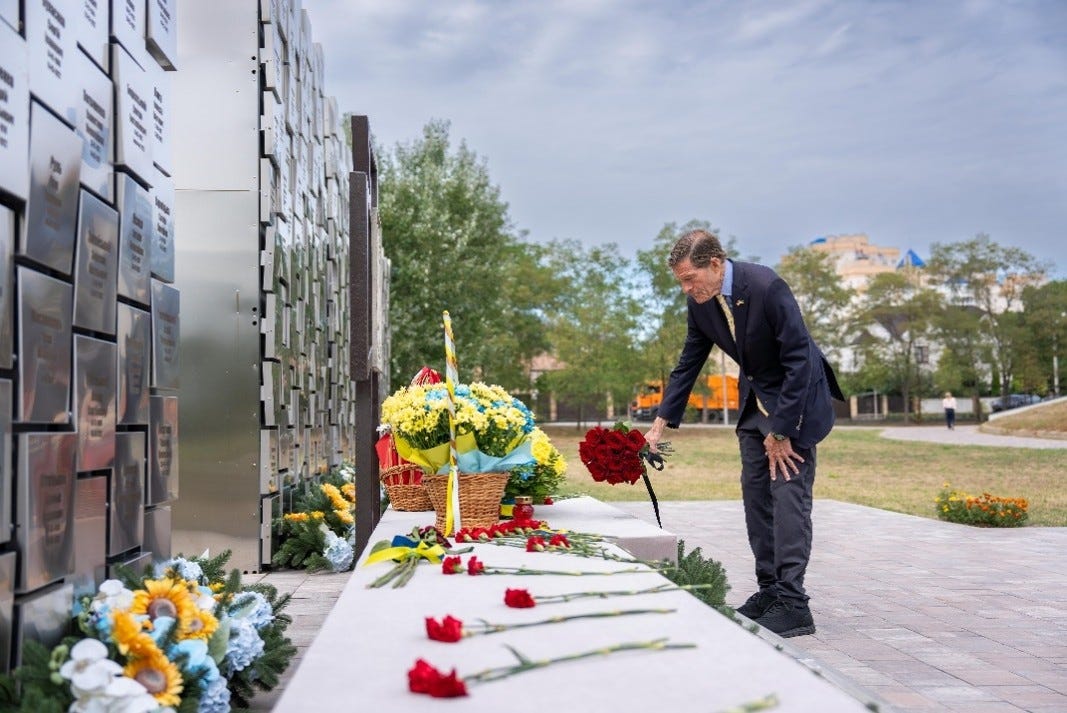
See more about my visit to Bucha here.
And the caregivers who work with children who have been victimized by Russians—abducted to be indoctrinated in institutions or foster families or abused in occupied territory. They have been rescued but have endured terrible suffering and emotional trauma away from their families. A group of youngsters gives me paper sunflowers that they’ve made that afternoon, their eyes and voices smiling as brightly as the flowers. Their resilience matches that of the soldiers.

See more about my visit with children and families here.
It’s Ukraine’s national flower, and this time of year sunflowers are everywhere—on windowsills, in office vases, on the exquisitely glowing fields along roads. Not exactly high tech, but their golden yellow hue is woven into Ukraine’s flag, along with the blue of its skies. And their value is far more than ornamental, yielding some of Ukraine’s most valuable agricultural products, like sunflower oil.
Putin can never bomb all the sunflowers. Nor can he destroy the Ukrainian people. His inhumanity has met its match, and more.
Thanks for reading The Blumenthal Bulletin! Subscribe to receive new posts.